


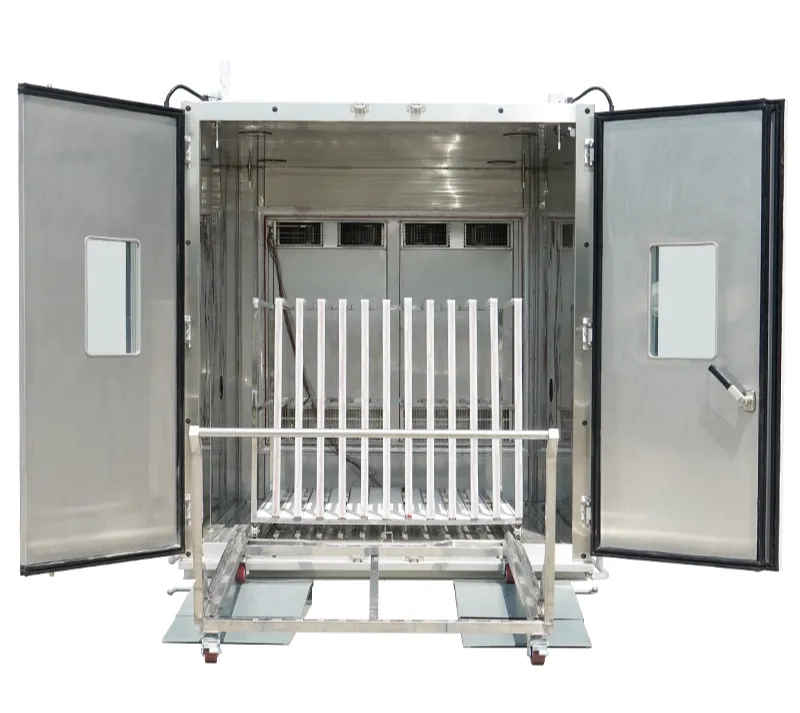
A complete reliability testing equipment lineup is not a longer catalogue. It is four groups of machines, each one aimed at a different failure mechanism, and it only becomes a real capability when you can move a sample from one group to the next without losing its history. Most labs we visit already own the first group and are missing the second, or own three groups that never talk to each other.
This guide follows the order a lab actually grows, not the order a product list is printed in. We will cover five things in sequence: why you should group machines by failure mechanism rather than by category, what the climate group settles and which chambers sit in it, what the mechanical group measures that a chamber never can, why vibration and combined testing belong together, and how the special environment group plus a shared workflow turn a collection of machines into one reliability programme. Then you can read your own equipment list against it and see the gap.
The short version, if you only read this far
- Group machines by the failure mechanism they force, not by the type of equipment they are.
- The climate group drives most field failures, so it is where almost every programme starts.
- The mechanical group answers force and displacement questions a chamber cannot touch.
- Vibration and thermal stress usually arrive together in service, so test them together when it matters.
- The lineup becomes a programme only when a sample can pass between groups with its records intact.
Step 1: Group Your Reliability Testing Equipment by Failure Mechanism, Not by Category
The useful way to plan a reliability testing equipment lineup is to group machines by the failure mechanism they can force, because that is the language your failure analysis already speaks. A catalogue groups by product type, which tells you what a machine is. A grouping by mechanism tells you what a machine can prove, and that is the question you are actually asking when a part comes back from the field.
| Failure mechanism | What drives it | The group that forces it |
|---|---|---|
| Corrosion, insulation breakdown, material ageing under heat and moisture | Sustained temperature and humidity over time | Climate group |
| Fracture, deformation, bond failure, connector wear | Applied force and displacement | Mechanical group |
| Fatigue cracking from motion, and failures that appear only when heat and motion act together | Repeated vibration, often combined with temperature | Vibration and combined group |
| Photo-degradation, mould growth, water ingress, altitude effects | Light, biological activity, water and low pressure | Special environment group |
Once the mechanisms are grouped like this, the planning question becomes simple. Which group is missing from my current setup, and does my next failure investigation fall inside it? Start the answer with the group almost every lab already owns, because that group also forces the most failures.
Step 2: The Climate Group, Where Most Programmes Begin
The climate group is where most reliability programmes start, because sustained heat and moisture drive more field failures than any other single mechanism. It is also the group with the widest spread of chamber types, so it helps to know which chamber settles which failure.
- High and low temperature humidity chambers handle steady and cyclic temperature and humidity. The WBE climate range covers -40, -20 and -70 °C classes up to +150 °C, humidity from 20% to 98% RH, with uniformity within 1.5 °C and fluctuation within ±0.3 °C. Two of those numbers matter more than the rest: uniformity is how evenly the whole workspace holds the setpoint, and fluctuation is how much a single point drifts. Both decide whether a result can be repeated by someone else.
- Thermal shock chambers force rapid change to expose joint and material fatigue quickly. The WBE-LR3 keeps the sample completely still, which is what lets you power it while it is being shocked.
- Rapid temperature change chambers run controlled ramps between 5 and 25 °C per minute. They are the workhorse for environmental stress screening, where the goal is to shake early failures out of a production batch rather than to qualify a design.
- HAST and PCT accelerated ageing chambers reach moisture-driven failure in a fraction of the time a damp heat test needs. Our HAST test chamber range meets JESD22-A100 through JESD22-A118 and can carry 4 to 128 biased terminals, and that terminal count is what lets you stress a populated board instead of a bare coupon.
- Aging chambers hold a product at an elevated condition for a long campaign, so slow mechanisms have time to show themselves.
Read that list as a set of failure mechanisms rather than a set of machines, and the group stops feeling like a catalogue. Each chamber exists because one way of damaging a product needs a specific combination of temperature, humidity and time. The climate group is the one nearly every lab owns, but it is not the group that explains a part that broke under load, and that is the next one.
Step 3: The Mechanical Group, Measuring What a Chamber Never Can
The mechanical group answers a different question: not whether the part survives time, but whether it survives force. A chamber can age a solder joint for weeks, and still tell you nothing about how many newtons it takes to break it. That number comes from this group.
- Electronic universal testing machines cover tensile, compression, bending, peel, puncture, friction and shear. The WBE-9809 series spans 100, 300 and 600 kN, and the Model B configuration is rated Level 0.5, which in plain terms means the force reading is trusted to a very small fraction of the value shown. That matters when you are qualifying a material rather than simply checking that it held together.
- Semiconductor bond strength testers measure the connections inside a package. Our WBE-9088B covers wire pull, ball shear, die shear, downforce and pullout, written as WP, BS, DS, DP and TP, on one platform, with independent crash and overload protection on each sensor so a mistaken move does not quietly shift the calibration.
- Automatic torque testers and insertion force testers cover connectors and threaded parts, where the failure is usually a weak or worn joint rather than a clean break. The WBE-6300D and WBE-6600 sit here.
- Desktop tensile testers handle small samples that a full-size frame would dwarf, and the WBE-9000BGD extends the same idea into a temperature chamber, so you can measure strength at temperature rather than at room temperature and hope it translates.
This group belongs in a reliability lineup for one reason. When a failure is finally measured, the number points back at a design or a process rather than at a guess. A joint that breaks below its expected load tells you something actionable; a joint that simply cracked after three weeks in a chamber tells you only that it cracked. The mechanical testing machine range lists the frames and the accuracy class for each model. But force alone is only half the story, because in service the part is usually moving as well, which brings us to the next group.
Step 4: The Vibration and Combined Group, Because the Field Does Both at Once
The vibration and combined group exists because field failures rarely respect the boundary between thermal stress and mechanical stress, and in the real world they arrive at the same time. A part on a vehicle or a machine tool is not first heated and then shaken. It is heated and shaken together, often for years.
- Electromagnetic vibration tables apply controlled sine, random or shock vibration on their own, which is the cleanest way to characterise how a structure responds to motion. The electromagnetic vibration table is the entry point to this group.
- Vibration test chambers add a temperature environment around a vibration test, so the part is warm or cold while it is being shaken.
- Combined temperature and vibration systems drive both at once, which is the closest a lab gets to the real duty cycle without going to the field. Our WBE-SZHKS arrangement is built for exactly this pairing.
Here is why the combined version earns its own group. A solder joint that survives a full thermal cycle, and also survives a full vibration sweep, can still fail when the two are applied together, because a material that is warm responds differently to the same input than one that is cold. Test the two separately and you can pass a part that will fail in service within a month. The vibration testing range shows how the table, the chamber and the combined system fit together as one platform rather than three purchases.
That gives you the four common mechanisms and the groups that force them. One group is left, and it is the one that decides whether a product survives a season outdoors.
Step 5: The Special Environment Group, Then Chaining Every Group Into One Flow
The special environment group covers the stresses that only appear in service, and its real value shows up when you chain all four groups into a single failure analysis flow. These machines are less about qualification in a lab and more about reproducing what a product meets once it leaves it.
- UV and xenon weathering chambers reproduce sunlight-driven degradation of polymers, coatings and seals, which is the failure that makes a product look old before it stops working. The UV lamp weathering test chamber range covers the common lamp types.
- Mould test chambers and rain or spray chambers cover biological growth and water ingress, two mechanisms that no amount of temperature cycling will reproduce.
- Solar radiation and low-pressure test chambers serve high-irradiance and altitude applications, where the stress comes from the environment itself rather than from the product running.
The lineup only becomes a capability, though, when the outputs feed each other. A mature lab usually runs the groups in this order:
- Start in the climate group to age the sample and reveal where the weakness is.
- Move the aged unit to the mechanical group and measure how much strength is left.
- Send it to the vibration group to see whether the weakened part now fails under motion.
- Use the special environment group when field exposure, not operation, is the dominant risk.
- Feed every result back through the same fixture, the same label and the same record format, so the second test knows exactly what the first one did.
That last step is what separates a programme from a collection. A lab that owns every group but cannot pass a sample from one to the next has a very well stocked room, and every investigation still starts from zero.
Because a lineup is bought once and lived with for years, the supplier behind it matters almost as much as the specification. WBE has been building reliability test equipment since 1995 from Dongguan, Guangdong, China, in our own 12,000+ square metre plant, and we hold ISO9001, ISO14001, CE, RoHS and CNAS. Standard models leave the factory in 15 to 20 days, and because we run our own sheet metal and machining centres we can build the non-standard fixture plate that ties two groups together. The full product range is organised so you can see which group each machine belongs to, and a separate guide on this site walks through the same grouping in more detail.
Frequently Asked Questions
Which group should a lab buy first?
The climate group, almost always, because heat and moisture drive more failures than any other mechanism and the group is the most versatile. Within it, a temperature and humidity chamber is the anchor, and a thermal shock chamber is the second purchase once rapid change becomes the point of the test.
Do we need a combined temperature and vibration system, or can we run the tests separately?
Separately is fine for screening, and it costs less to build your capability that way. Combined becomes necessary when a product is known to fail in the field despite passing both tests alone, because that pattern is itself evidence that the two stresses interact. Buy the combination when you have that evidence, not before.
How much does grouping by mechanism change the machines we buy?
It rarely changes the machines. It changes the order you buy them and the fixtures you specify. When you plan by mechanism, you notice that two groups need to share a sample carrier or a temperature range, and those small decisions are what make the second machine useful the day it arrives.
Where does accelerated ageing fit in the flow?
Accelerated ageing, whether a HAST chamber or a long-term aging chamber, sits at the front of the climate group. Its job is to compress years of service into weeks so the mechanical and vibration groups have a realistic sample to test, rather than a factory-fresh one that has never seen a hard day.
A complete reliability testing equipment lineup is not defined by how many machines sit on your floor. It is defined by how many failure mechanisms you can force, and by whether a sample can travel between them carrying its history. Group the machines by mechanism, cover the four groups in the order your failures demand, and the room stops being a collection of equipment and starts behaving like one programme.
Map your lineup against the four failure groups
Look through the climate, mechanical, vibration and special environment groups, see which one is thin, and we will help you plan the order that keeps every sample moving forward.
Explore the equipment range Plan your test workflow